A chimney cap is one of the most important defenses against water damage, pests, and masonry deterioration. Yet many Minnesota homeowners don’t realize how vulnerable their chimney is until problems appear. At Sheridan Sheet Metal, we’ve seen firsthand how failed chimney caps and chase covers can lead to expensive repairs throughout Minnesota homes.
Think about what makes your roof effective: it’s a continuous, sloped surface designed to shed water away from every vulnerable joint and seam. Your chimney has none of those advantages. It rises above the roofline as a vertical column of porous masonry, and at its center sits an open flue, essentially a direct channel from the outside environment straight down into your home. The Chimney Safety Institute of America confirms that water penetration is the single largest contributor to chimney deterioration and masonry failure. That’s not a minor maintenance footnote. That’s a structural reality every Minnesota homeowner should understand.
The National Fire Protection Association puts it plainly: “A chimney without a cap is like a house without a roof.” Without protection at the top, rain, snow melt, and ice all funnel directly into the flue. In a climate where freeze-thaw cycles hit hard from November through March, that moisture doesn’t just sit there, it works its way into mortar joints, expands when it freezes, and accelerates masonry decay season after season.
The primary role of a chimney cap, or in the case of a wood-framed chimney, a steel chimney chase cover, is to act as that missing roof. It seals the top of the chimney chase against moisture intrusion while still allowing vent pipes to pass through safely. It’s a straightforward solution to a real structural vulnerability. Before we get into why a custom-fabricated cover outperforms a standard off-the-shelf cap, it helps to understand exactly what we mean by “caps,” “crowns,” and “chase covers”, because these terms get used interchangeably, and they’re not quite the same thing.
Flue Cap, Crown, and Chase Cover: Understanding the Differences
These three terms get used interchangeably all the time but they describe three completely different components, each doing a distinct job at the top of your chimney system.
The chimney crown is a masonry or concrete layer that seals the top of a brick chimney’s outer structure. It slopes away from the flue to direct water off the masonry and prevent it from soaking into the chimney’s core. When a crown cracks, water works its way into the brickwork itself, a slow but serious problem.
The chimney flue cap is the smaller metal cover that sits directly over a clay flue opening. Its primary job is to block rain, debris, and animals from entering the flue. A proper chimney cap installation also includes a spark arrestor mesh to prevent embers from escaping. Caps are relatively compact and designed to fit a single flue tile.The chimney chase cover, by contrast, is the full metal “lid” that fits over the entire top of a masonry or wood-framed chimney system. Where a masonry chimney has a crown, a chase-style chimney has this cover and it’s a much larger, more structurally significant piece of sheet metal. If you have questions about which component applies to your chimney type, our FAQ page covers the most common scenarios.

The confusion between these terms is understandable. They all live at the top of the chimney, and they all manage water in some way. But once you know the difference, it’s clear why a standard cap swap doesn’t solve a failing chase cover and why the cover’s design and material matter far more than most homeowners realize.
Why a Custom Chase Cover Outperforms Standard Designs
A flat chase cover isn’t just uninspiring, it’s a slow-moving water damage problem waiting to reveal itself.
The issue is straightforward. When water lands on a flat surface with no pitch, it sits. That standing water, commonly called ponding, accelerates rust on standard galvanized steel covers, often within just a few years of installation. What begins as surface oxidation works its way through seams and edges, eventually allowing water to migrate into the chase cavity below. By the time a homeowner notices a problem, the damage is often already done. Routine chimney cleaning and inspection appointments frequently uncover deteriorated covers that have been quietly leaking for a season or two.
The fix is a fabrication technique called cross-breaking. A cross-broken cover has a subtle pyramid shape pressed into the metal panel, creating a consistent slope in all four directions from the center. Water sheds toward the edges immediately, eliminating any opportunity for ponding. It’s a straightforward engineering solution but it requires custom fabrication. Factory-stamped flat covers simply don’t include it.
Material selection matters just as much as shape. Here’s how the common options compare:
- Galvanized steel — The most common factory choice. Affordable upfront, but prone to rust when the zinc coating wears through, typically within 20–30 years in harsh climates.
- Painted steel — A significant step up in longevity. Highly resistant to rust and corrosion, making it well-suited for Minnesota’s freeze-thaw cycles.
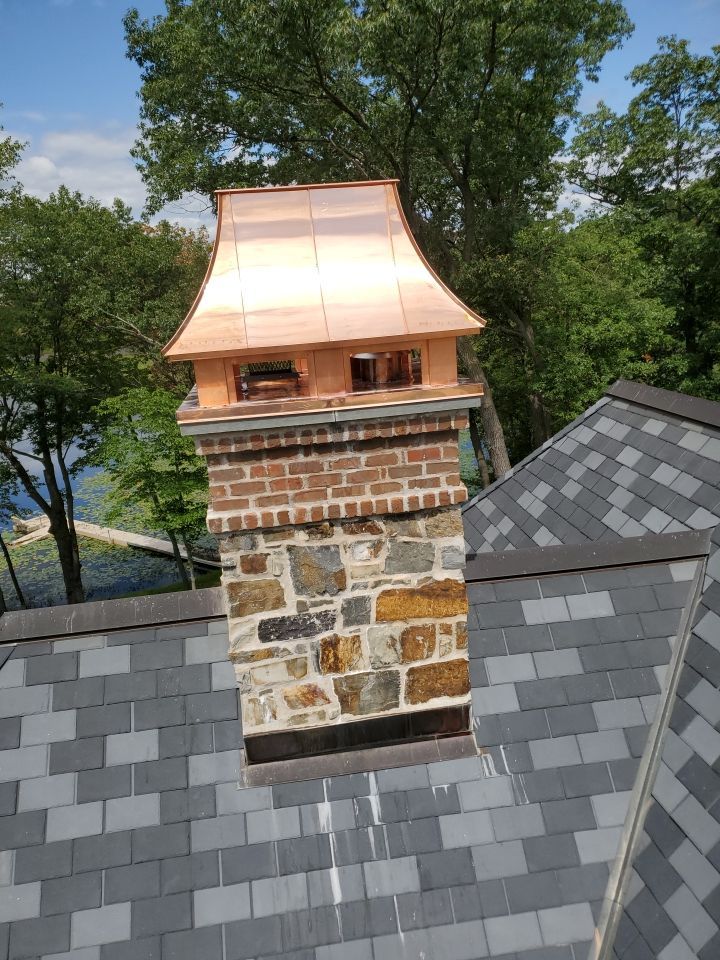
- Copper — The premium choice. Naturally corrosion-resistant and develops a protective patina over time. Per the Copper Development Association, custom-fabricated metal covers specifically prevent the ponding effect that leads to premature rust and leaks in standard factory-installed units.

Beyond material and slope, fit is everything. A custom-fabricated cover is measured and formed to your chase’s exact dimensions, ensuring the drip edge the folded lip that directs water away from the chase walls, overhangs correctly on all four sides. A cover that’s even slightly undersized will allow water to run down the chase exterior rather than clear of it. That’s precisely the kind of detail our custom metal fabrication work is built around. Of course, a well-engineered chase cover is only one layer of protection. Next, we’ll look at how decorative shrouds fit into the picture and why combining aesthetics with function requires some careful attention.
Chimney Cap vs. Decorative Shroud: What Homeowners Need to Know
A decorative shroud can make your chimney look like it belongs on a custom-built estate, but without the right functional components underneath, it can also create a serious safety hazard.
A shroud is an architectural enclosure, not a protective system. It wraps around the top of the chimney to create a finished, intentional look, hiding the flue liner, the cap, and any mechanical components from view. For homeowners investing in curb appeal and cohesive exterior design, that visual payoff is real. Shrouds can be fabricated from copper, steel, or other metals to complement rooflines and siding in ways that stock components simply can’t match.

The safety concern, however, is significant. A shroud that isn’t designed with proper airflow and clearance in mind can trap heat around the flue and create a fire hazard. This isn’t a minor technicality. It’s the kind of issue that surfaces during masonry and chimney repair inspections when something has gone wrong.
The right approach pairs a properly functioning chimney cap with a separately fabricated shroud that doesn’t interfere with ventilation or clearances. Here’s how to think through that combination:
- Pros of decorative shrouds: Strong architectural appeal, hides mechanical components, customizable to match your home’s design language, adds perceived value.
- Cons of poorly designed shrouds: Heat trapping risk, potential code violations, may void insurance claims, can interfere with draft performance.
The functional cap, the component actually doing the work of blocking water and wildlife, has to allow for proper airflow. The shroud wraps around it for aesthetics. When those two roles stay clearly defined, you get both performance and a finished look. When they’re conflated, you get risk.
Because every roofline, flue configuration, and clearance requirement is different, we recommend that the fabrication design of any custom chimney top be done in coordination with an HVAC and/or fireplace professional, to ensure proper venting from the start. That clear-eyed approach to component design connects directly to another layer of chimney compliance worth understanding: the height rules that govern how any cap or shroud must be positioned above the roofline.
The 3:2-10 Rule and Local Compliance
Safe chimney height isn’t a suggestion, it’s a code requirement that directly affects draft performance, fire safety, and how your custom cap or shroud gets designed.
Once the chimney caps vs shrouds explained debate is settled and you’ve chosen the right combination of components, there’s still a non-negotiable technical standard to address. The International Residential Code (IRC) establishes the 3:2-10 rule, and it applies to every chimney regardless of how well it’s built or how attractive the shroud looks.
The rule breaks down into three clear criteria:
- 3 feet — The chimney must extend at least 3 feet above the point where it passes through the roofline.
- 2 feet — It must rise at least 2 feet higher than any portion of the building structure within a 10-foot horizontal radius.
- 10 feet — That 10-foot measurement is taken horizontally from the chimney in all directions.
Why does this matter? Proper height creates the pressure differential that draws combustion gases up and out. A chimney that falls short of these minimums creates negative draft, pulling smoke back into the living space and increasing the risk of dangerous creosote buildup. In a Minnesota winter, when stack effect inside a warm home is at its strongest, that risk is amplified.

For custom cap and shroud design, these height requirements aren’t just background knowledge, they’re active design constraints. A decorative shroud that looks proportional but doesn’t account for the chimney’s required clearance height can actually interfere with proper draft if it restricts the flue opening or adds unnecessary resistance. Getting this right means measuring carefully before fabrication begins. That’s precisely where a custom-built solution outperforms anything pulled from a catalog. The details covered here, material choice, structural integrity, functional components, and now code compliance, all feed into a single outcome: a chimney system that protects your home for decades.
The Bottom Line: Protecting Your Investment
Custom chimney protection isn’t a luxury upgrade, it’s the most cost-effective way to defend your home against Minnesota’s full range of weather punishment.A properly installed custom chase cover, paired with the right cap, is the single most reliable barrier between your home and water, animals, and fire risk. Galvanized covers fail because they rust at the seams. Stainless steel and copper don’t. In a climate that cycles from sub-zero winters to humid summers, that material choice determines whether you’re scheduling a repair in five years or in fifty.

Animal entry accounts for a significant portion of chimney-related service calls, and the fire hazards that follow, according to the Humane Society of the United States. A well-fitted cap closes that opening entirely. Combined with a cover that seals the top of the chase, you eliminate the two most common entry points for pests, debris, and moisture in one coordinated solution.
The 3:2-10 rule for chimneys isn’t optional, either. Meeting that height standard is a baseline safety and draft requirement, and any custom cap or shroud we fabricate has to be sized and positioned around it. Skipping that step doesn’t just create a poor draw; it creates a code violation. Professional installation ties all of it together. A watertight seal at the cover’s edges, proper fastening through freeze-thaw cycles, and warranty coverage that actually holds, these outcomes depend on the installer as much as the material. As you’re weighing your options, it’s worth thinking about how chimney protection fits into the broader picture of your home’s exterior water management, from the roofline down to your drainage system. In the next section, we’ll look at what custom fabrication built specifically for the Twin Cities climate means for your project.
Custom Fabrication for the Twin Cities Climate
A chase cover that fits your chimney precisely, fabricated locally, backed by a warranty, and installed by people who know what Minnesota winters actually demand, is the difference between a fix that lasts and one that fails within a season.
Local manufacturing matters for one straightforward reason: no two chimneys share the same footprint. A cover produced off-site from standard dimensions gets you close, but “close” isn’t good enough when freeze-thaw cycles are forcing water into every gap that’s a fraction of an inch off. At Sheridan Sheet Metal, we fabricate your chase cover to exact measurements, cut and formed right here in the Twin Cities. There’s no guesswork, no shims, and no sealant patches trying to compensate for a poor fit.

That precision is reinforced by a 5-year warranty on our custom work, a reflection of 75+ years of local expertise and our confidence that what we build will hold up. We’re not hedging. We stand behind the seams, the miters, and every weld.
The path from inspection to solution is simpler than most homeowners expect. You describe the issue, water staining, rust bleed, a damaged cap, and we evaluate the full system. We’ll scope the project clearly, explain the material options in plain language, and give you a timeline that fits your schedule, not ours. If you’re a homeowner dealing with a failing chase cover, or a contractor sourcing custom architectural sheet metal for a project, we’re ready to work alongside you. Whether you’re replacing a rusted chimney cap or need a custom chase cover fabricated to exact specifications, Sheridan Sheet Metal provides locally manufactured solutions backed by decades of Minnesota experience and a 5-year warranty.
Frequently Asked Questions
A chimney cap sits over the top of your chimney flue and acts as a protective barrier against rain, snow, debris, and animals. It also helps prevent downdrafts and includes spark-arresting mesh to reduce the risk of embers escaping. Without a chimney cap, moisture can enter the chimney system and contribute to costly masonry damage over time.
A chimney flue cap protects the flue opening itself, while a chase cover protects the entire top of a prefabricated or wood-framed chimney chase. Think of the chimney cap as a protective cover for the vent and the chase cover as the roof over the entire chimney structure. Both components play important roles in preventing water intrusion and extending the life of your chimney system.
Yes. The National Fire Protection Association recommends protecting chimney openings from weather and debris. A properly installed chimney cap helps keep water, leaves, nesting animals, and other contaminants out of the flue while allowing smoke and combustion gases to vent safely.
A high-quality stainless steel chimney cap can last decades when properly installed and maintained. Unlike galvanized steel, stainless steel resists rust and corrosion, making it an excellent choice for Minnesota’s harsh weather conditions and frequent freeze-thaw cycles.
Signs of a failing chase cover include rust stains on the exterior of the chimney, water leaks near the fireplace, visible corrosion, standing water on top of the cover, or deteriorating seams. If you notice any of these issues, it’s a good idea to have the chimney inspected before water damage spreads to the surrounding structure.
Absolutely. A damaged or improperly fitted chase cover can allow water to enter the chimney chase, where it may affect framing, insulation, drywall, and adjacent roofing materials. Because the damage often occurs out of sight, homeowners may not notice a problem until significant repairs are needed.
Custom-fabricated chase covers are designed to fit the exact dimensions of your chimney and can incorporate features such as cross-breaking to promote water runoff. This helps prevent ponding water, improves durability, and creates a more reliable seal than many standard factory-made covers.
Stainless steel and copper are generally considered the most durable options. Both offer excellent resistance to corrosion and can withstand Minnesota’s weather extremes. While galvanized steel may have a lower upfront cost, it typically has a shorter lifespan and is more susceptible to rust. Painted steel offers a good balance and can add beauty to a home.